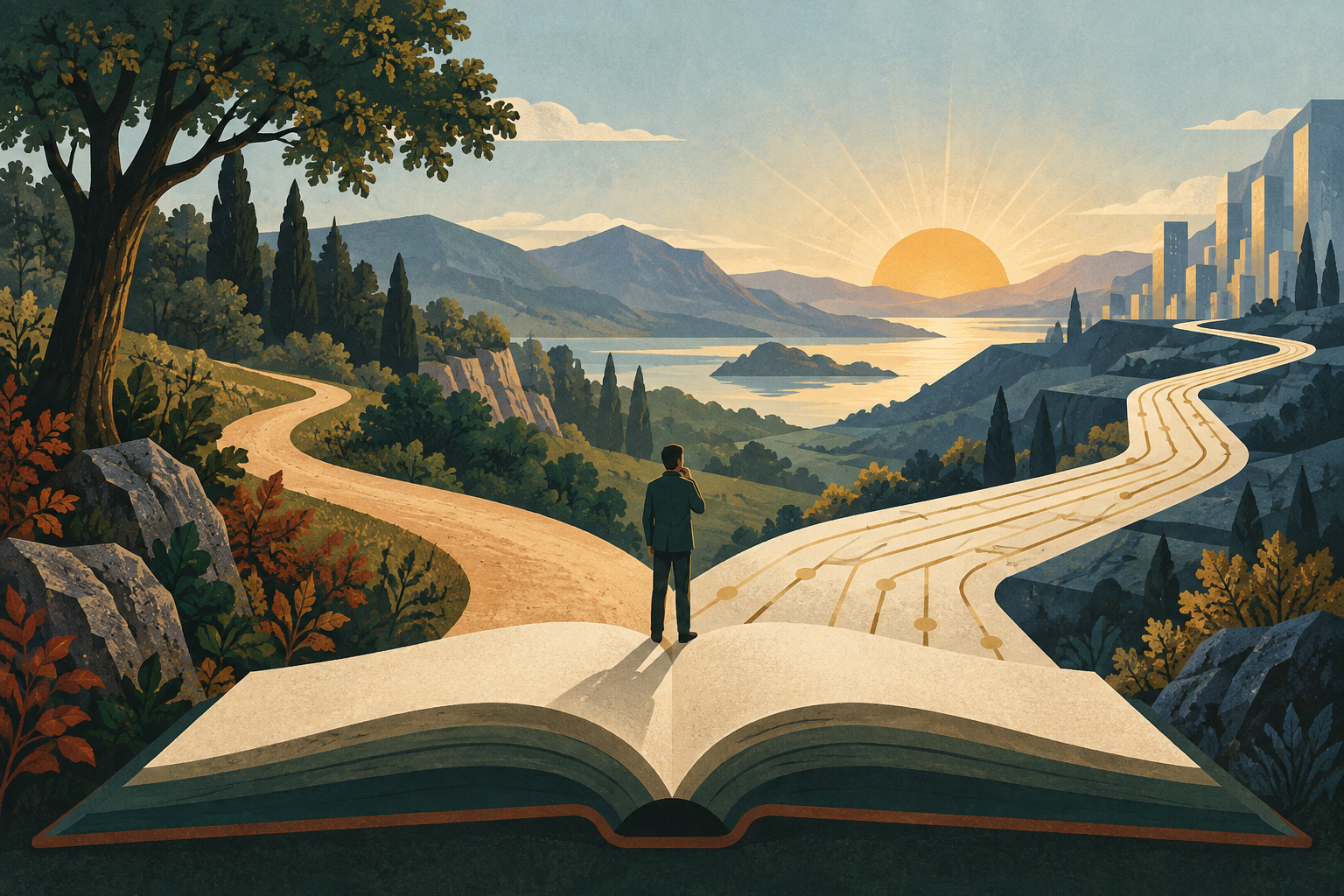
None of us own a crystal ball to give us answers to the endless questions regarding how AI will impact our individual lives and the world in general. Yet we can speculate based on our intellect and wisdom; how right we are won’t be known until it is played out in the years to come. So here is this old man’s assessment.
“Artificial it is, but intelligent—no way.”
Certainly, AI cannot be held back. Too, there is just no way to control or slow its advance even though many, I for one, believe it should be controlled. It would be like traveling back in time to the industrial revolution and trying to control the advances so it wouldn’t pollute the environment or endanger lives. Even if the U.S. were to somehow limit the advance or use of AI, other nations will keep advancing at lightspeed with no restrictions.
So, is AI opportunity or misfortune? The answer is clear—yes, it is. There are thousands of ways AI will benefit one’s individual life and the world in general. Advances in science and technology due to its ability to process data at lightning speed, automate routine or repetitive tasks without error in seconds that would take humans much longer, working 24/7 without a break, minimize human error, carry out complex analytical and decision analysis in seconds, and so much more, will benefit us in untold ways.
The greatest opportunity for AI is in the medical field. No doctor can regurgitate an encyclopedia of disease diagnostics or image analyses for every disease—AI can. More than a decade ago I worked with a CDC scientist and AI company and wrote a proposal on how to use AI to win the war on cancer. I was convinced, and still am, cancer can be easily defeated. Universities, research hospitals, pharmaceutical companies, and independent research laboratories throughout the world have undertaken extensive research in the innumerable ways cancer cells grow, spread, take over organ systems, and how they can be stopped. Much of that research is proprietary or secret, especially in the pharmaceutical industry. Often, many laboratories are duplicating research not knowing others are working the same problem. If all research were to be open AI, duplication would be eliminated but more importantly, radiological, biochemical, and biological links between different research areas would be quickly identified by AI and merged to solve the research in question.
Cancer is nothing more than a giant biological/biochemical/radiological jigsaw puzzle. Open AI would quickly fit together the pieces of the cancer puzzle scattered around the world’s research facilities to complete the cancer puzzle and end cancer altogether—I’m sure of it.
The misfortunes of AI are many. Goldman Sachs estimates up to 25% of current work in the US and Europe will be lost to AI, while Boston Consulting Group project up to 15% of jobs eliminated in the next 5 years. Work Economic Forum predicts 85 million jobs will be displaced globally. Will that same number of new tech driven jobs be created? I think not. I believe those estimates are too low for AI is advancing exponentially, not so with new job creation.
College graduates are already feeling the difficulty of securing positions related to their degrees, and are thus working in white and blue-collar jobs. In Japan workers in fast food restaurants are already being replaced by robots that flip burgers, build soups and salads, and deliver, with each meal precisely the same, never a mistake. This is good for the store owner but not the workers who are laid off.
I believe the gravest negative impact of AI will be, (and already is), in replacing creative work. Not only will it replace people doing the creating, it will quietly reduce the growth of creativity in the minds of youth. Students today are using AI to complete reports in minutes that would otherwise take hours of research in a library. They are generating essays, short stories, poetry in mere seconds using not a shred of their own creativity, just an AI algorithm. AI can produce an entire movie with actors who look identical to the real actor and have their precise voice—identity theft as its worst.
Being a writer and poet, what I create on paper is a product of my life’s experience, joy, happiness, sadness, mistakes, decisions (good and bad), guilt, sorrow, love, loss, empathy, and so much more. AI ususes none of that yet can write an entire novel in no time with merely a few prompts. Could an AI generated novel win an award for outstanding literary achievement? I’d like to think not. And does it matter to you as a reader if a poem, essay, or novel is AI generated or created by a writer? That’s for you to answer. Are you even able to discern if something is AI generated, not likely. This past month alone I’ve received AI generated letters from two different thieves who stole the name and photograph of legitimate editors from noted publishing houses to try and steal my work. They used AI to read my existing publications and spat out details and compliments which almost convinced me they were legit.
Creative arts are under attack by AI. A talented artist created the thirty illustrations for my children’s book. Each took her hours of creative talent to complete. It would be impossible for me to draw a little girl pulling carrots in a garden with other farm animals nearby. Well, I can now produce (as opposed to create) such a drawing in mere seconds using AI. I no longer need an artist. So, which is better? You will need to decide for yourself. AI doesn’t use intelligence or creativity to produce the illustration, it merely steals from existing libraries of artwork or photographs, copying the binary code, and altering pixel placement as directed. It’s an algorithm and has nothing to do with “intelligence” let alone “creativity.” Artificial it is, but intelligent—no way.
Let’s not give AI more than its due for AI is a misnomer, a true contradiction. AI is in reality AA, for there is nothing intelligent about it. It is simply Artificial Analysis. It doesn’t think or create, it’s not a thought process. It merely collects billions of digital binary codes made up of only two characters (0 and 1), which it analyzes and then manipulates according to an algorithm to spit out a different combination of 0’s and 1’s. That’s analytical, not intellect.
AI is here to stay and advancing at light speed. The benefits are many, but they come at great cost. The world will take on an entirely new complexion over the next decade. We can’t control it as some may think, but as it reaches into nearly every crack and crevasse of our lives and the world around us, those who are wise will use it for the positive. Sadly, there are the foolish, selfish, mad, and evil individuals and organizations that will use AI for wrath, retribution, thievery, animosity, feed their egos, make money, and everything else bad.
Will the benefits outweigh the misfortune? Yes and no—it depends entirely on your perspective and situation. My prediction is that AI will greatly benefit the wealthy and large corporations, while negatively impacting a large sector of the middle class and poor. One thing is certain; our lives and the world we live in will be impacted. TJ
This page presents Timothy’s complete original essay.
Visit the original archive ↗