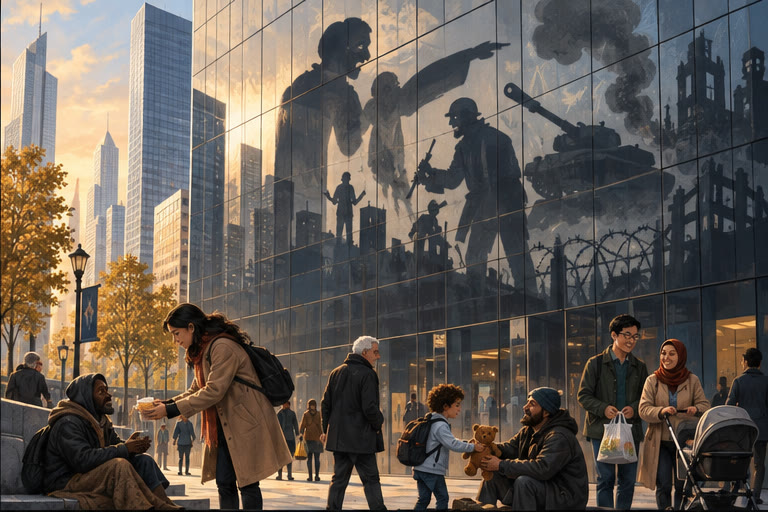
UNCIVILIZED CIVILIZATIONS
All around us today nations are at war with each other, declared or undeclared. Worse, some are even at war with their own populace, killing, with no conscience, innocent civilians from infants to the elderly. The U.S. seems to be constantly debating whether or not to go in to “hopefully” stop the brutality, which always raises the question of the value of a life (infant or adult), albeit one on the other side of the world. I doubt any compassionate person would assess little or no value on a life, so it comes down to placing a dollar and responsibility value instead. So here we sit in our beautiful safe homes wondering what the truly right thing do to is, forgetting completely that our perspective is heavily biased by our comfortable and serene life. (We don’t hear or feel the bomb or bullets or gas, nor are our streets and homes being destroyed.) Sadly, for the most part, we put it out of our minds.
Think “Sigmund Freud” and you probably conjure up “The First Shrink”, but you would be so wrong. This thinker told us what was to come, and why. Way back in 1929, Sigmund Freud put his thoughts together in his book Civilization and Its Discontents. He said, “The first requisite of civilization is that of justice”. He explains that any civilization that leaves so many people wronged and mistreated, does not deserve a lasting existence, and in fact, it will not survive. What Freud was saying is that any nation/country/society, large or small, must be built on fairness and equality for all; otherwise, its people will rise up, rebel, and give their very lives for freedom; that governments or dictators will all eventually fall unless their people respect them. It may not be tomorrow, but finally the masses will stand up for their respect and freedom rather than their so called leader.
Freud spells out the many fundamental tensions that can exist between a government or ruling body and the populace, but boils them down to a couple of basic principles, and boy was he right-on. The primary friction is when a person’s desire for freedom, (which is instinctual), is contrary to the demand for conformity and repression according to the leader’s dictates. Literally, when happiness/freedom is restricted by law.
He goes on to explain that the characteristic instinct of freedom is immutable, and if obstructed, it brings to the surface the predisposition of aggression towards the authority that takes away that freedom. And by freedom, Freud included all, including religious beliefs.
Even earlier (1927) he published his thoughts wherein he criticized organized religion as “…a collective neurosis,” not in the negative sense, but saying that it can help a civilization because it gives a sense of community by having the same beliefs. The danger, however, is that it can exact an enormous psychological control on those believers and can make them totally subordinate to their God, or their father figure, dictator, or leader of their religion.
Look around us today, and look back as well, how often is/has “religion” been the motivation for hate, war, and terror? When Freud was in Vienna, Hitler and the Nazis invaded, and Freud left. He told his friends he wanted to die a free man, not under tyranny. And he goes on to write about Hitler’s philosophy, the poor Jewish people, and how such a malaise can afflict so many in modern civilizations. Freud told us that people will, without question, become neurotic when they cannot tolerate what a government or society or religion “imposes” in the so called service of its ideal: the German race is superior so cleanse the world of Jews; Islam is the only true religion so flying planes into buildings is honoring the religion; ethno-nationalistic conflict in Northern Ireland between Protestant and Catholics; the civil war over freedom for blacks; and on and on. Bottom line—without freedom for all, there will be conflict.
What amazed me is that so many “civilizations” around the world, correction, the “Leaders and governing bodies” of these so called “civilizations,” can’t see the obvious. If they just simply look at all the nations and governments that give “Freedom” to their people, why in hell can’t they get it through their heads that “It Works?” That when freedom prevails, people are happy and the society flourishes. Why can’t they see that in all these free nations, there are no limits to how a person can worship. That when no person is inferior due to race or belief, all is peaceful and positive.
It saddens me beyond measure that in all these uncivilized civilizations, people like you and me, with families and children, are being raped, brutalized, and killed simply because they want what you and I have, FREEDOM, and are standing up for their wish to be free. And when we are asked what we, the U.S. should do about it, do we merely empathize with their horror, and shed a tear for a dead child, or do we try in some way to bring about their freedom? Will shooting and bombing them bring them to their senses or change their reasoning? How many must we kill to stop them from killing? Can brutality bring about an end to brutality? Will they ever allow freedom of belief? Can any measure of reason teach them peace is wondrous? Does a man (or group/country) who believes it is proper to kill all who do not believe in his god, deserve to live? If “kill or be killed” is reality, does this make killing them just? Is it any different from killing the man or woman wrapped in explosives or holding a gun to your head?
Should money, reputation, security, world image or the desire for the freedom of all people and a wish for civilized civilizations be the basis for our decision? And if indeed we want freedom for all and a world of peace, how can it be accomplished without killing? Is it any different from removing a cancer from our body? Just what is our alternative? Do we do something about it or ignore it and let the evil cancer continue? Must we be uncivilized to become a civilized world? tj