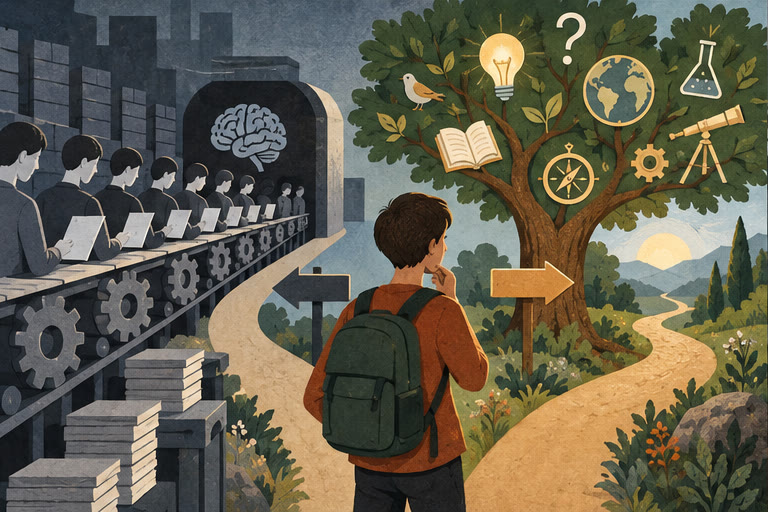
Though I am no “Expert” on education, I believe strongly that our systems and testing requirements must be changed. My BS in Ed. prepared me for “teaching” in the classical sense, and I taught grades 7 through 12. As well, I was a college professor, and of course a “student,” (just as all of us were). One cannot be a student, and a teacher, without gaining a perspective of what went right and wrong, what worked and did not work. When I recount my early schooling as well as my early teaching, and relate it to teaching today, it is quite clear to me that we truly need to restructure our primary and secondary educational systems. What is startling is that it hasn’t yet taken place.
I was a terrible student. I nearly flunked 7th grade (I had to be tutored to pass) and the only thing I liked about school was the kids. I was a horrible test taker and hated memorization. I felt like a robot being fed data and facts to then regurgitate on a test paper to prove my robotic mind functioned properly; obviously it didn’t for my grades stunk, and when I got a ‘C’ I was elated—the only ‘A’ I ever got was in conduct, and I’m certain none of my teachers thought this robot would earn a PhD.
Many significant publications spell out the problems in our school systems and detail smart solutions, and they are right on, yet decade after decade we remain stuck in the rut of traditional teaching methods. I don’t understand why, except maybe administrators haven’t a clue how to change what has been the rule since writing first took place on stone tables, or perhaps because it is easier than fighting the system. For certain, the U.S. Department of Education is not aware of those innovative teaching publications, and I’m wondering if any of them ever “Taught School.” A quality teacher clearly sees the problem–yet can do nothing about it.
Our state educational systems, driven by the U.S. Department of Education, “demand” teachers follow specific guidelines and use standardized achievement tests. Because we believe, as we should, that “All” children deserve to be educated, we dictate a uniformity in teaching in fear that a teacher may be lazy or just not be a good teacher. Bottom line, we turn the classroom into an education factory assembly line, forcing every factory worker—teacher—to follow the same procedures, use identical tools, teach the same facts (way too many) so every student will pass the same standardized test. These factory schools fill the entire United States, and day in and day out teach the same things; and it is only getting worse (more directed). Kids are not bottles of soda to be filled with the same mundane syrup of facts; each is a unique individual with unequaled aptitude, desire, gifts, and potential. What the Department of Education fails to understand is that no guideline can improve a poor teacher, and by penalizing good teachers by taking away their creativity, we are penalizing our children and likewise taking away their creativity.
When I taught 7 through 12 at Northwestern High School in the wonderful small town of Mendon Missouri, I was fresh out of college with a BS in Zoology and a BS in Ed. Biology from Truman State University 60 miles away. Back then there were no “State Guidelines” telling me how to teach. I selected the texts books and developed my own curricula for each of the five different science courses I taught every day, with a sixth course the following year where the students received three-hours of “College Credit” for the advanced course. I loved every second of teaching. It was challenging, hard work, and it was fun, and I can honestly say, I “loved” many of my students as if there were my own children. Remembering clearly how much I hated school, I endevored to make my courses enjoyable, even for the kids that hated school or hated the subject. I had a bathtub full of earthworms, glass walled ant colonies, large natural aquarium, cage after cage of mice and white rats, hydroponic beds, flesh eating beetles (to clean animal skeletons), ALL in my small classroom. I had an aquarium of minnows, with wires at one end to administer a mild DC current so the kids could determine if fish can see colors and which colors. Kids used different kinds of soap and shampoos on white rats to see how the fir/skin was affected, and we even had a smoking chamber to see the effect of cigarette smoke on rats—all those experiments today would be considered animal cruelty. I showed them how to be inquisitive and ask questions–and find answers. I taught combustion principles by having my kids build rockets and setting them off during a school assembly outside for all to watch. I even got a chauffeurs license so I could drive a school bus full of students to university lectures and do field experiments, because the school wouldn’t pay for the driver.
I did my level best to teach concepts and processes, along with a few facts, and to have the kids design their own experiments based on those concepts, rather than me telling them what to do. I endeavored to teach my kids ‘how to think’ and to make thinking fun and challenging. AND I graded my students on their ability to think, understand, and explain, rather than on what ‘facts’ they could regurgitate through memorization on a multiple choice test. I wanted my kids to “understand” what the Krebs Cycles was, why it’s so important, what it does and how, but I didn’t expect them to memorize the whole complicated cycle—I couldn’t, so why should they? I explained that a cell was like a factory, and asked them what was needed for any factory to work, then compared it to how a cell worked.
If I were to teach high school today as I did then, I would be fired. And likely, my student who went on to become the head of the science department of a prestigious Canadian university, and another who won state awards, and many others, just may not have done well on today’s state exams simply because I didn’t force them to memorized facts and figures that I knew they would never retain. Goodness, Mortimer Adler (born 1902) knew this more than 100-years ago–see quote above. When will we realize that REMEMBERING FACTS IS NOT INTELLIGENCE? Most of my kids loved science because I gave them an understanding of “science” not because they knew a bunch of facts.
Our present system of education is premised on the ability of kids to “Pass” standardized tests, and sadly, those tests are largely multiple choice questions listing “facts,” one correct and four incorrect. The student needs to have that “fact” firmly in their brain to get a good grade. Few, if any questions, measure a student’s ability to assess, reason, think, and conclude—that can only be determined through essay questions. A high test score requires memorization and regurgitation, not thinking and explanation. And the sad thing is our teachers have no recourse but to teach regurgitation. Teachers will have kids memorize a poem, while great teacher will have them understand what that poem was saying, and then have them write a poem (what good results from memorizing a poem?–none). Kids are told to read great works of literature (which is wonderful), while the great teachers have them also write a story. “Memorization” is not learning. Igniting a child’s curiosity and building the mind’s fire of interest and question is true teaching. Yes, there are inferior teachers in our schools as well as gifted, creative, and bright teachers with the right ideas, ideals, goals, and methods. But our present system constrains and shackles them just so all students might pass those pathetic exams designed by idiots who think they know how to test for intelligence—what a joke.
The Greek Philosopher Plutarchus said it best: “The mind is not a vessel to be filled, but a fire to be kindled.” He was one smart fellow and born in 46-AD for heaven’s sake, yet here we are nearly 2,000 years later and we still haven’t caught on. It is so basic, logical, and so simple to understand that preparing a child to ponder, assess, question, reason, conceive, investigate, and ‘think’ on their own, is far and away better than having them memorize facts and figures which they will soon forget. Instead of earning High School Diplomas, perhaps we should be granting High School PhD’s, for that’s exactly what we are doing, merely Piling on the facts Higher and Deeper.
I’m wondering, will we ever comprehend what good old Lucius Mestrius Plutarchus understood so long ago, and start building fires in the minds of our kids? How about we teach concepts, processes, creativity, and inquisitiveness; and instead of facts, reveal the greatness of science, literature, history, mathematics, physics, geology, biology, zoology, poetry, creative writing, and on and on. Teach them the love of knowledge, rather than pile on simple facts, so long after they forget the minutia of those memorized facts, they retain the love of knowledge and continue to create and produce new knowledge. When will reason override regurgitation? Or will it?
Superior teaching is hard work, it requires dedication, creativity, knowledge, skills, EMPATHY, and emotional intelligence – all of which are squashed by forcing our teachers to follow dumb guidelines and administer pathetic test. Unless someone with power and influence takes the lead, and is able to rally enough bright educators with wisdom and a vision of what education should be, and force the U.S. Department of Education to change their primeval education policies and ridiculous standardized testing, and release the shackles on our great teachers, I fear we’ll be teaching the same way in another 2,000 years—how sad is that? Someone please step up to the plate, force that change—for our children and our nation. tj